
90s marketing or was there something there?
-
-
I'm curious about this too. TechT still has Hush bolts with a venturi face for sale and I'd like to know if they're all hype. -
90% hype. The only real benefit is the area of the "venturi*" holes is less than that of the usual single super-cavernous hole most "high flow" bolts have today. And one of the biggest tricks you can to for a 'Cocker (and to a lesser extent others, like a Spyder) is to let the gas expand as little as possible between the valve and the ball.
The big, open "high flow" bolts don't do anything but let the gas column expand unnecessarily- wasting some of the energy stored in the compressed gas- before it hits the ball.
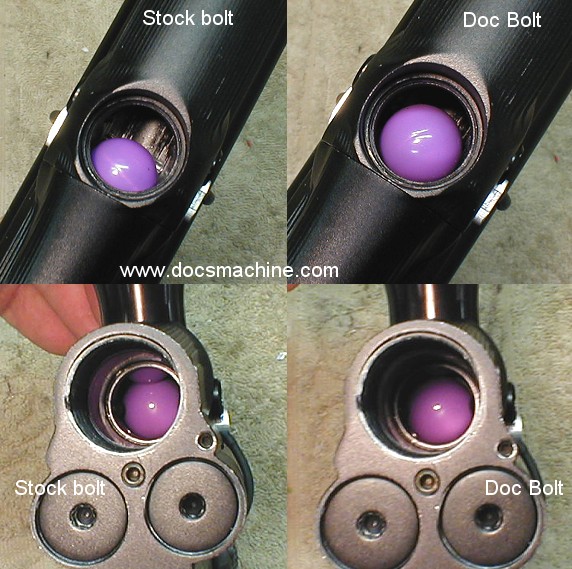
Here's an example: The bolt on the left came in a customer's P&P Supercocker. He wanted "more flow" so he had me make the bolt on the right.

And even today, almost everyone would pick the right-hand bolt- it's more open, therefore it flows better, therefore it's better, right?
Nope. The left-hand "venturi" bolt was worth 35-40 FPS, no other changes. Regular as clockwork; Venturi, 285-290 FPS, all day long. Swap in the open bolt, with no other changes- same gun, same paint, same setup, same pressure, etc.- 245-250 FPS, all day long. Swap the venturi back in, 285-290.
Had nothing to do with the "venturi" part- it was simply the fact the inner volume of the venturi didn't let the gas needlessly expand.
Doc.Doc's Machine & Airsmith Services: Creating the Strange and Wonderful since 1998!
The Whiteboard: Daily, occasionally paintball-related webcomic mayhem!
Paintball in the Movies!Comment
-
Venturi has always been a huge hype and used for marketing purposes.
I won't speak for other marker types but as a career low pressure Spyder builder and user, I see this differently than Doc. An open face, higher flowing bolt design is what I will use 100% of the time.
Comment
-
Have you tried a truly small-bore bolt? In my experience you'd practically have to make one, as save for a few Venturi styles, most are pretty cavernous- including the stock bolt.
Ideally what you want- in a 'Cocker at least- is the entire gas passage should be the same size from the valve to the face of the ball. I'd be very surprised if you didn't see more or less the same effects on a Spyder- other than the fact no one makes such a bolt, because thanks to marketing, no one would buy one.
It's worth noting that when I was initially testing my Evil Twin (an over-under double-barrel 'Cocker) I needed to 'choke off' one barrel to help divert air to the other. I made a test bolt, meaning to start with a weeny bore- 3/16", or .187"- and expecting to bore it larger in stages 'til the velocities were about the same.
I got something like 260-270 out of that barrel. On a double-barrel. With a 3/16" bore on the bolt.
"Flow" isn't the issue. The pressure and impulse time is too short for that to be a factor- yes, even on a "low pressure" marker. Maintaining the energy of the gas charge is the key.
Doc.Doc's Machine & Airsmith Services: Creating the Strange and Wonderful since 1998!
The Whiteboard: Daily, occasionally paintball-related webcomic mayhem!
Paintball in the Movies!Comment
-
I ain't gonna come here with some fancy science words, but anecdotally I have found that venturi bolts can change the sound signature of a marker. I like them on my Sniper builds as they seem to cut down on farty shot sounds💀 PK x Ragnastock 💀Comment
-
I do have a delrin bolt of unknown make with an opening that isn't as large as a stock bolt but is a little bigger than a Sheridan bolt. The trouble with that one is there are no orings on it.
Flow is semantics I suppose and I use it that way, not scientific. I also have a Smart Parts Evolution bolt for the Spyder. They are the most restrictive bolt I've found for the Spyder as they have only six holes.
Due to the design differences it is difficult to compare cockers to Spyders as apples to apples when dealing with lower pressure operation. I can have a cocker cycle at very low pressure (but the velocity won't be usable) however the Spyder can't even cycle.
I agree with what's quoted. I've achieved this in Spyders by enlarging the hole between the two tubes above the valve. That point is the most restrictive to air movement in a Spyder. The modification takes advantage of aftermarket valves and bolts, most of which have adjacent holes larger than the one between the tubes.
This is also what AKA was aiming for in the later middle 90's, though they tackled it before, at, and after, the valve.
I've broadened for what the OP was asking by going into a system rather than just one part of a system and I apologize for the hijack.
Comment
-
Venturi bolts are better in one specific area. Friends that turn bolts upside down at fields don’t get satisfaction from Venturi bolts. So you just need the check for quarters then.Comment
-
I'm the asshole who pulls this prank on people. One of my favorite is an Empire Sniper. It's not easy to turn the bolt upside down (doable, but takes time/effort)... but it is easy to put it in backwards! You'd think it would be visually obvious, but people regularly miss it. I also like to turn electric gun BPS cap down to whatever their lowest setting is.
-
-
In fluid mechanics it's known as "Hydraulic Damming" or the Bernoulli Principle.
The constriction forces the air to accelerate through the smaller holes. When air accelerates, it loses pressure.
It's a trade-off between pressure energy and kinetic energy. The total amount of energy remains constant.
So, it's not merely 90's hype. There is a sound scientific principle behind it.Comment
-
-Absolutely not a hijack. This isn't a case of "I'm Doc, dammit, what I say is LAW!" or anything like that. I've been known to be wrong before- once - and I 100% admit I haven't so much as touched, let alone modified, a Spyder (or similar blowback) in a good number of years.
But, that said, the physics are sound, and I'd be very surprised if a similar effect wasn't found on a Spyder as on a 'Cocker.
I will say, though, that it sounds like you were tuning Spyders specifically for low operating pressure. And there, too, 'low pressure' is a side effect, not a goal in and of itself.
That goes along with the open-bolt thing; again, everyone assumes "to get low pressure, you need high flow", etc.
What AKA was doing back in the day, was, first and foremost, tuning for efficiency. The low pressure was part of that- it let you pull deeper into a tank, getting more shots per fill. There was no other reason to go low pressure.
Marketing hype- especially Smart Parts with the Shocker- pushed it as a 'huge performance gain' and all that, and the players picked up that ball and ran with it just as they did venturi bolts, barrel porting as "rifling" and slotted "high flow" valves.
My examples, as always, have been the Phantom and the 'shoebox' Shocker. The Phantom runs at straight CO2/HPA pressures (about 850 PSI) and is widely renowned as accurate and efficient. The Shocker ran at about 160-170 PSI and while considered accurate, was a massive gas hog. The operating pressure is irrelevant.
You want to tune the gun to be as efficient as that combination allows, regardless of what pressure it runs at. And one trick that helps that, is a bolt that doesn't let the gas charge expand too much before it can reach the ball.
Doc.Doc's Machine & Airsmith Services: Creating the Strange and Wonderful since 1998!
The Whiteboard: Daily, occasionally paintball-related webcomic mayhem!
Paintball in the Movies!Comment
-
What sometimes amazes me is that there are quite a few tuning theories that tend to get ignored, mostly since they don't have some number you can use to keep score. Low pressure was easy, "hey look, got mine down to 300psi". "Not bad, got mine down to 250, beat that!"
While experimenting with the concept I almost on accident stumbled on a rather different idea, a "low force" build. Instead of how low could I get the regulator to read, it was how light of a main spring could I have opening the valve. This was on blowbacks of course, and mostly in-line designs. On stacked tube designs the natural binding of two parts moving together made it harder. But while tinkering with a low pressure Stingray concept, and waiting for the regulator I needed to arrive, I ended up with a gun that needed a ridiculously light main spring. So light that if a ball was slighter oversized (remember when that was ever a concern? It's been a while) the gun would actually stop cycling.
Did the same with a Tippmann build more recently. Maximized the valve flow, lightened the valve spring, aftermarket powertube that never had a velocity choke screw, aftermarket RVA backed all the way out, lightest main spring in the kit, and I still had to lower the operating pressure down to like 350psi to keep the velocity field legal. Smoothest shooting A5 variant I've ever handled. Made it magfed to boot, wasn't sure if the cyclone would still do it's thing.
Ok, back on topic. My one concern on a small hole bolt face is that I've had a few (mostly cheapy blowbacks) that were hard on paint. The small bolt opening almost seeming like hitting the ball with a powerwasher jet. On one, if I ever get back around to messing with that one, it's on the bottom of the tinkering pile, my idea was to first open the hole a bit, but then install a flat head allen screw into the front of the bolt as a diffuser of sorts. Instead of a small jet hitting the center of the ball, it's a narrow ring spread out around the full face of the ball. Also this makes the face of the bolt flat, so a ball can't roll back into the hole of the bolt and mess with feeding.Comment
-
-I used to believe that too, but I very much doubt it's a thing. The paintball takes X amount of force to accelerate to 300 FPS, regardless of the way it's applied.Ok, back on topic. My one concern on a small hole bolt face is that I've had a few (mostly cheapy blowbacks) that were hard on paint. The small bolt opening almost seeming like hitting the ball with a powerwasher jet.
I recall back when Kaye was developing the Level 10- or had recently released it- he said they'd measured how much breech pressure there was at the instant the gun fired. And he was surprised to find that everything they tested, from the standard Automag to the then-new Impulse, had around 95 psi at the breech.
Which, as I said, makes sense- 300 FPS is 300 FPS. Give or take very minor tolerances for a very tight or a very loose bore, any gun using air pressure to accelerate the ball, should, at the moment they make contact, use pretty much the same pressure to do so.
That was the key to the L10- it wasn't the air pressure on the ball, it was the bolt force. The air conforms to the surface of the ball, spreading out and contacting pretty much the entire hemisphere- the bolt doesn't. The big trick to the L10 was that it slowed and reduced the force on the first half of the bolt travel- sure, on the order of milliseconds, but that was enough.
Put it this way: There's already more-or-less atmospheric air pressure in the bolt passage before the ball is fired. When the valve opens, a column of pressurized air starts moving up the passage- and while it does so, it starts compressing the air ahead of it.
There is little holding the ball in place in a 'Cocker, just a tiny bit of friction. So that initial air pressure- not yet peaked- already starts moving the ball and spreading out to conform to the shape. Once the main burst gets to the ball, it's already a small distance away from the bolt face, and already moving. Again, a difference on the order of milliseconds, but enough there's almost certainly no concern with a "jet" or "spike" of high pressure gas.
With a "cheap blowback", I'd wager a bunch any excessive breakage is far more likely to be the bolt impact speed (especially if the ball is not resting on the bolt face) and the same thing Tom found when designing the L10 and the major issue for most of the Angels: It's the second ball that breaks. Demonstrated here on an unmodified '04 Speed- specifically the lower left corner:
This kind of thing is partly bad breech design (the Angels were godawful, compared to the design quality of the rest of the gun) and only made worse as the paint gets smaller.
And, that's also a byproduct of the "cavernous bolt" issue- the big openings let the chambered ball roll backwards, and the more it does, the more the next ball in the stack can intrude on the breech.
And what you get- as Kaye found- is that it wasn't the ball in the breech that broke, it was the passing bolt hitting and cracking the underside of the next ball in line. The cracked bolt would then fall into the chamber, and blow out when fired.
The Speeds I put those original bolts in, went from breaking 8-10 balls per game to 1-2 per day.
.... But I digress a bit.
Thing is, none of this is new. Bud Orr himself told me about the bolt passage sizes at the '98 APL Tournament in Anchorage, and Kay found out about the breech pressure and 'second ball' issue when he was developing the L10 in what, 2002 or so?
Unfortunately, for most people, marketing is more powerful than anything some schlub on the internet can tell you, so people will keep using the most open bolts they can find, and cranking down on the springs so they can show people 160 psi on the gauge, and they they have a great and well-tuned setup.
Doc.Doc's Machine & Airsmith Services: Creating the Strange and Wonderful since 1998!
The Whiteboard: Daily, occasionally paintball-related webcomic mayhem!
Paintball in the Movies!Comment

Comment