Something a bit special: The semi-official 30th Anniversary of my Second-Oldest Marker! 
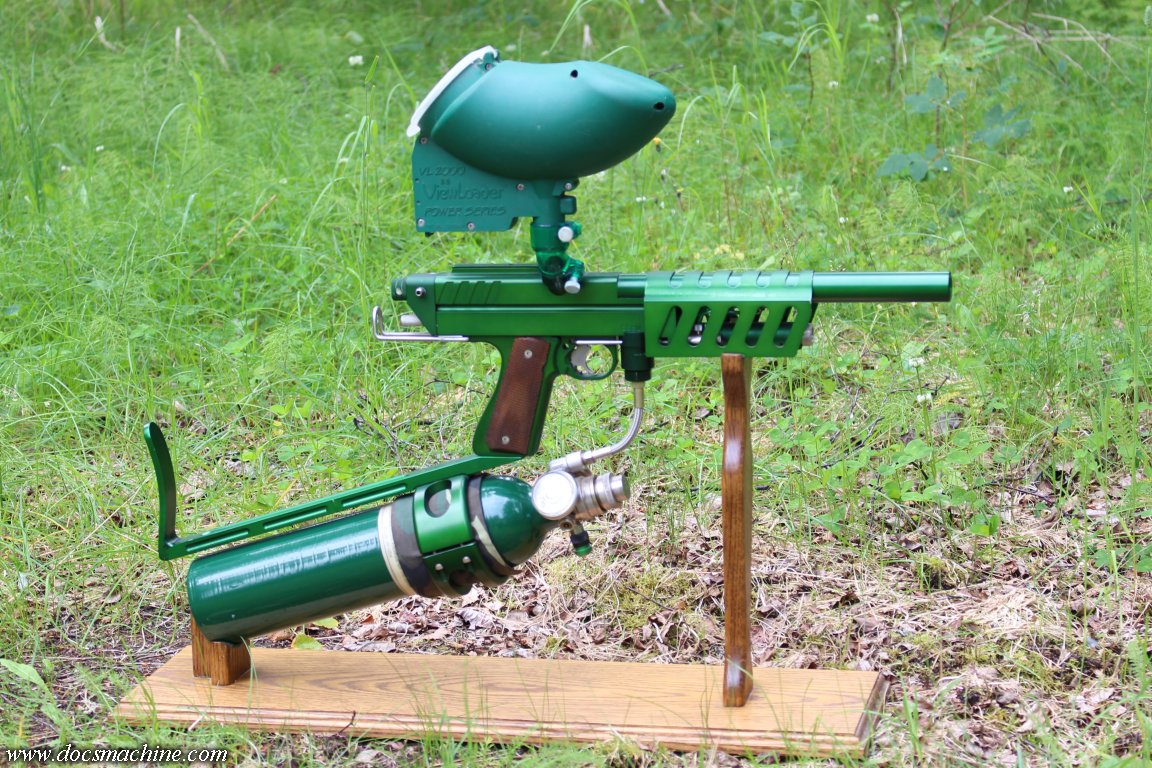
And I've actually had it even longer than that. It's the first AutoCocker I ever owned, it's the first marker I ever milled/machined (heh, okay, with a proper milling machine ) the first one I ever had anodized, the first one I ever ran on HPA, and the first one I ever made a display stand for.
I picked up the base gun, used, in... I think 1993. In '94 I got my first milling machine, a badly-worn mill-drill, and by '95, I'd done some very basic milling to the body, based on pictures from the magazines at the time, added the HPA tank and a bunch of bolt-on goodies, and had it anodized.
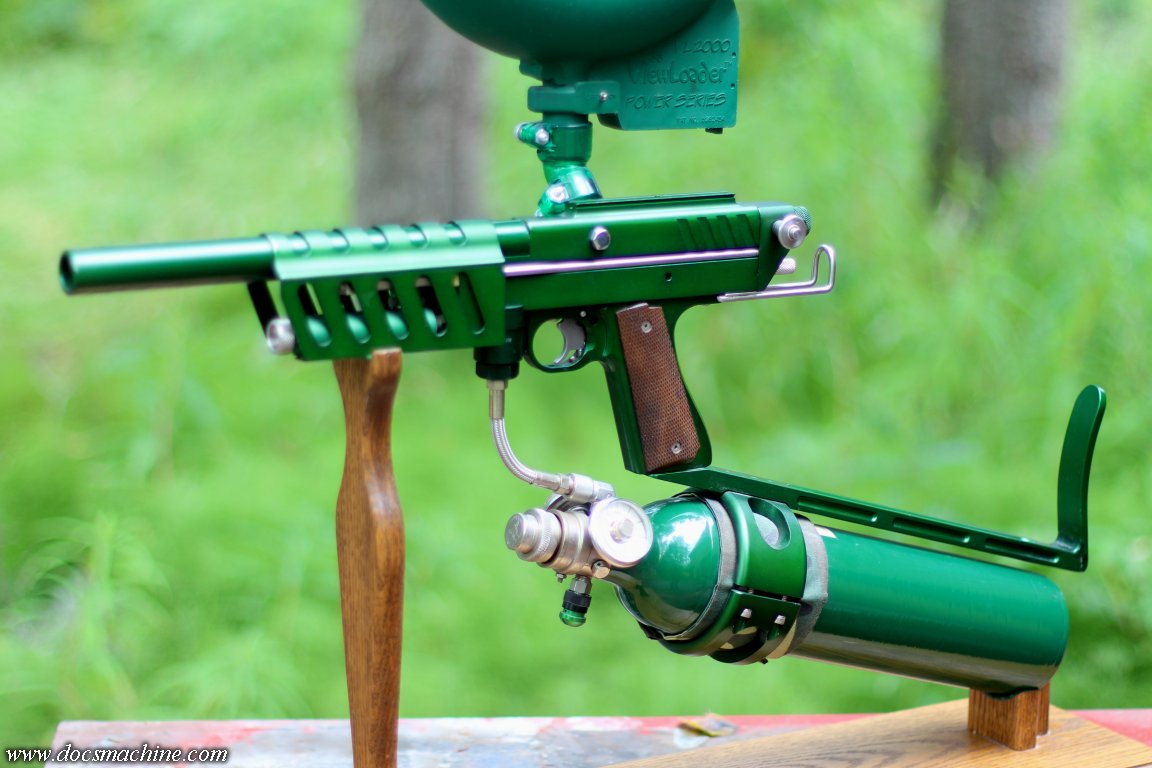
It took me a long while to piece it all together- the TASO grip frame cost, I think, $75, and I had to make payments on it.
And, naturally, I made some mistakes along the way- buying the wrong parts, buying accessories based on their ad-hype only to find out said ad was 98.9% bulls**t, and making the usual rookie mistakes. One of which was I did the body milling without stripping the original black anodizing off. The shop that did the green, was an industrial anodizer, and so there's spots like this...
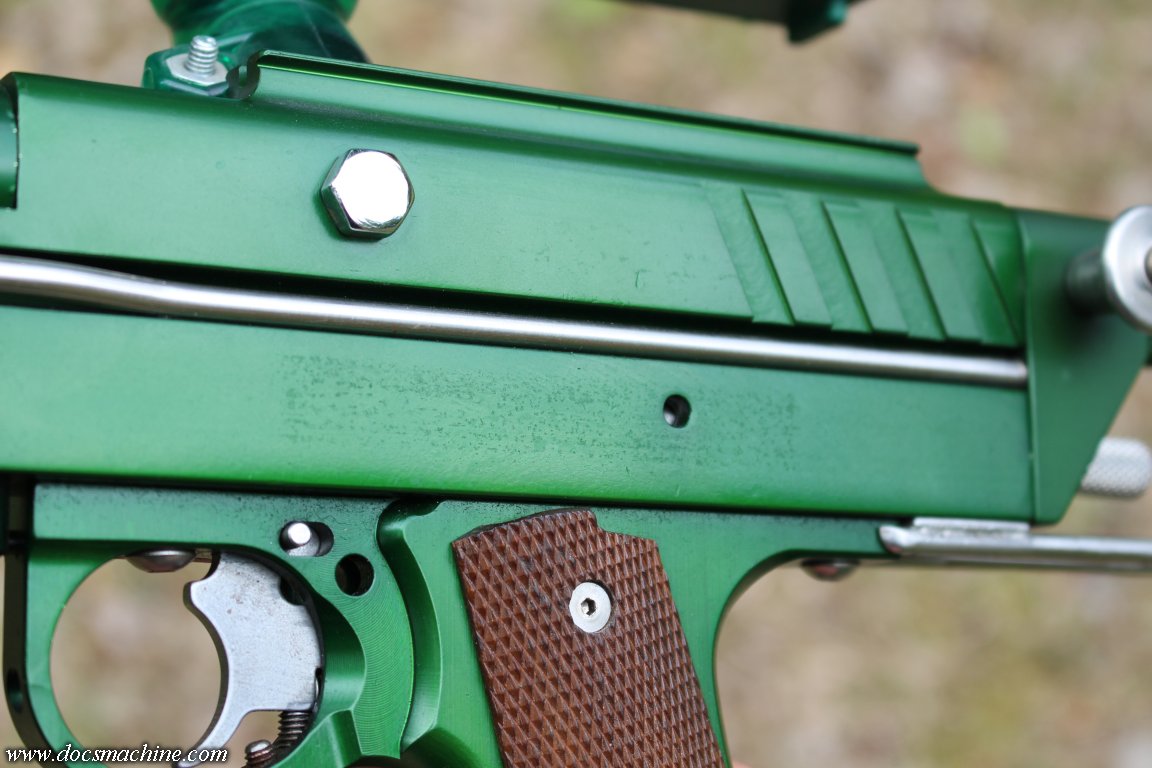
... Where there was apparently a faint trace of the adhesive from one of those typical "this is not a toy!" stickers, which caused pitting when it came time to replate.
Same goes for the front shroud:
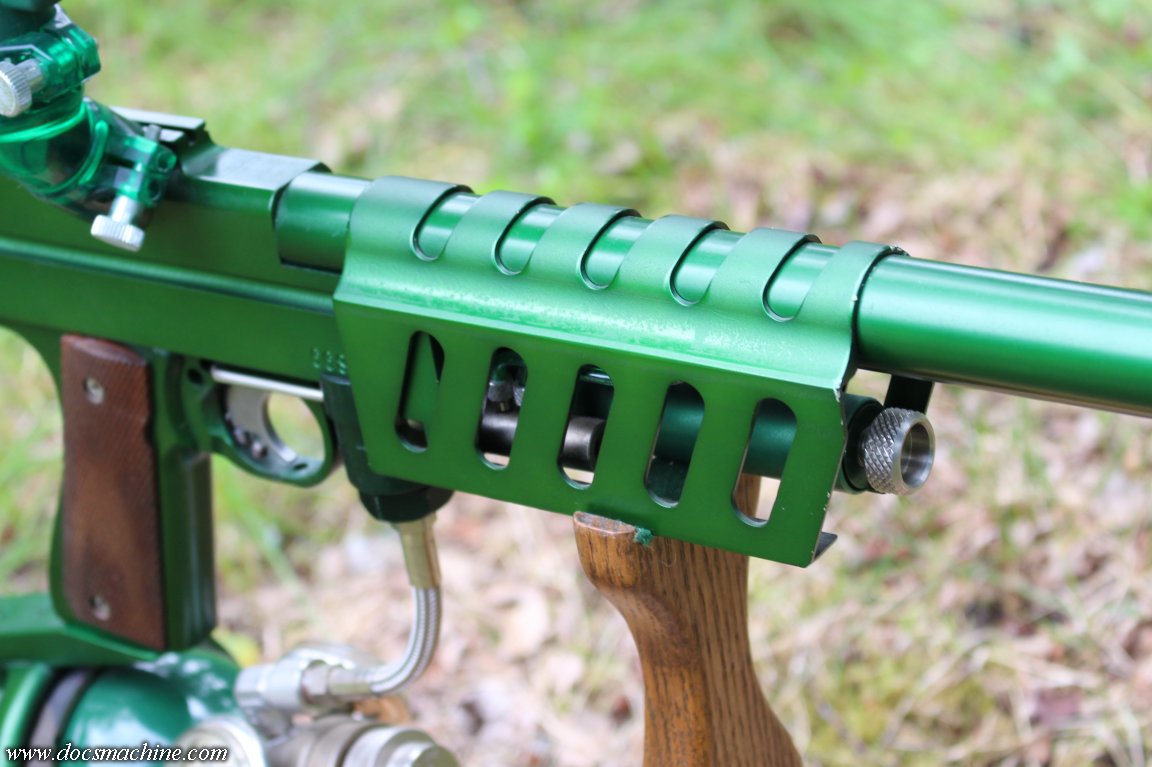
The upper grooves were a common feature even back then- mainly on the early Evolution 'Cockers- but the side grooves were, at the time, unique. Also note little tricks like the hollow TASO "Rock" Knob- that was one of my signature touches back in the day.
Under the shroud was cutting-edge for back then, but of course a bit antiquated today. Palmer's Rock LPR, Clippard "mini" ram", and a custom-nickeled Palmer's 3-way (pre-Quickswitch) that with the nickeling cost me $65 at the time. And that was mid-90s money, which is almost $140 today!
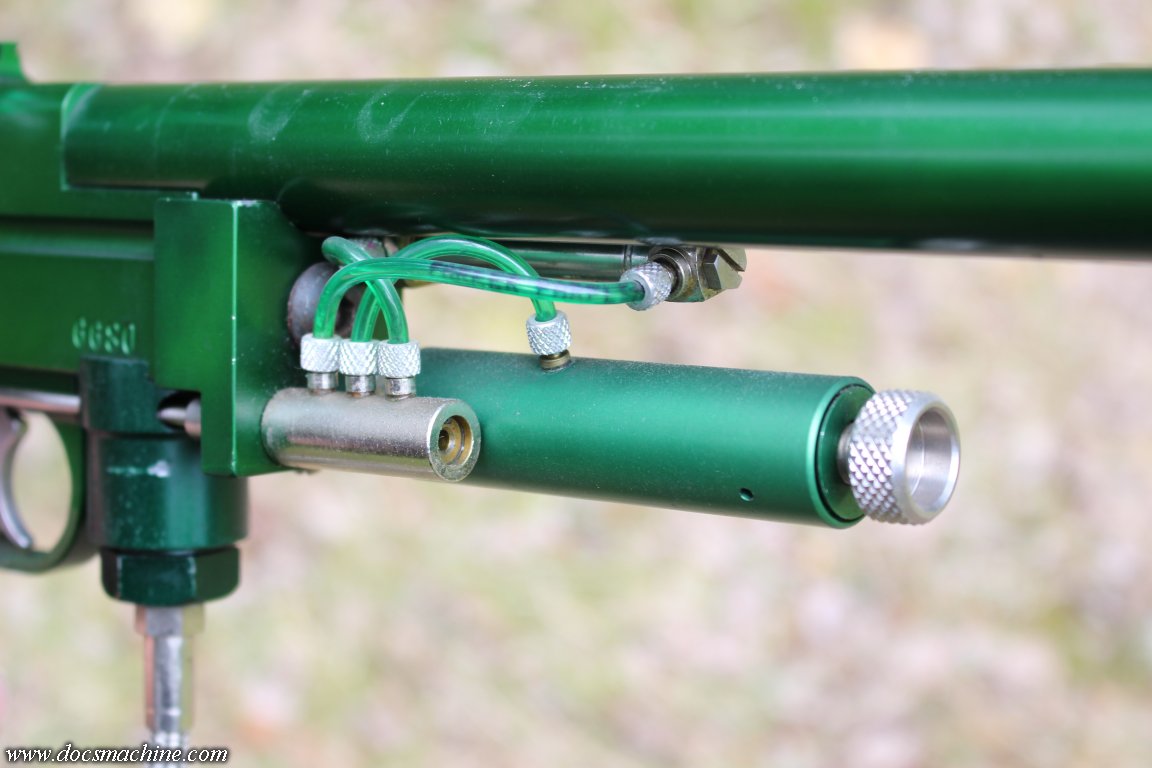
As I recall, the 90-degree banjo at the end of the ram cost me another $40 (Palmers custom-nickeled that for me, too) and the colored hoses were just starting to appear on the market.
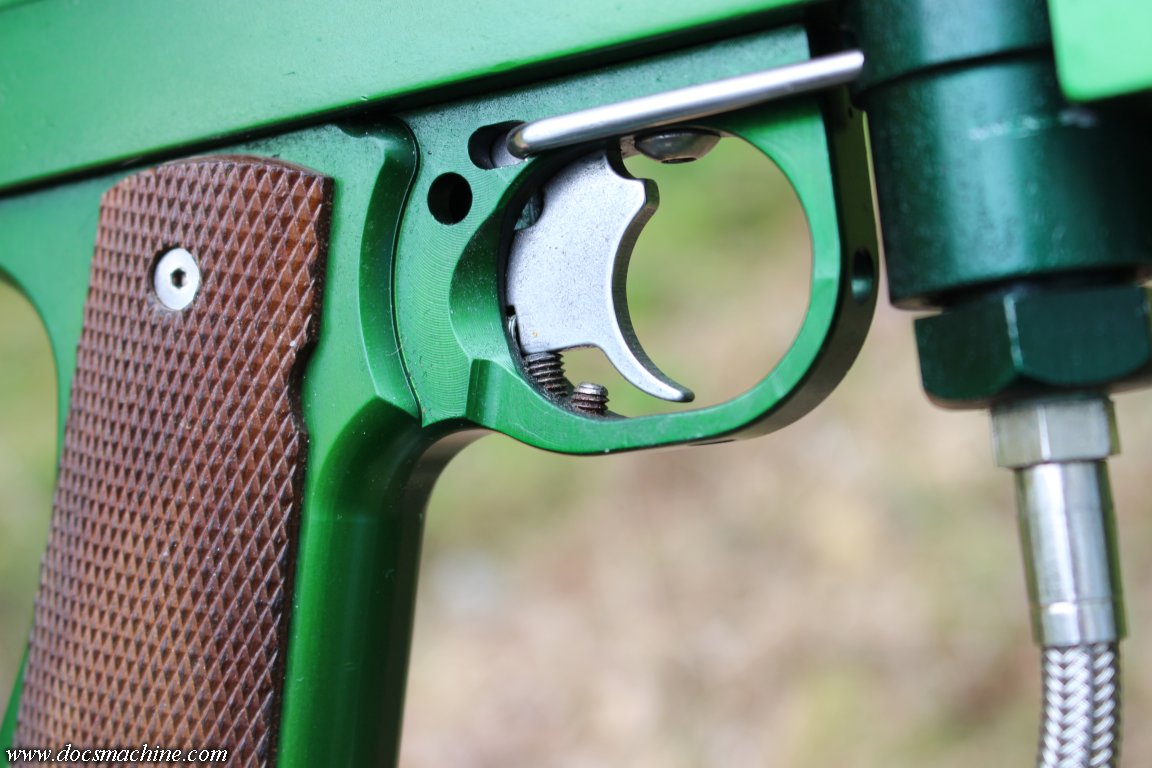
Other little tricks: the TASO frame came with a threaded hole for the vertical-slop adjuster screw (though I ground the end flat, polished it smooth, and rehardened it) but I added the smaller one as a trigger stop. I believe the trigger plate and sear are aftermarket, but I can't recall from who- they, too, might be TASO, which was one of the bigger dealers back in the day.
Out back is an unmodified 'Cocker back block, a TASO "venturi" bolt, and some no-name stainless cocking and pump rods. The beavertial is 100% custom, though.
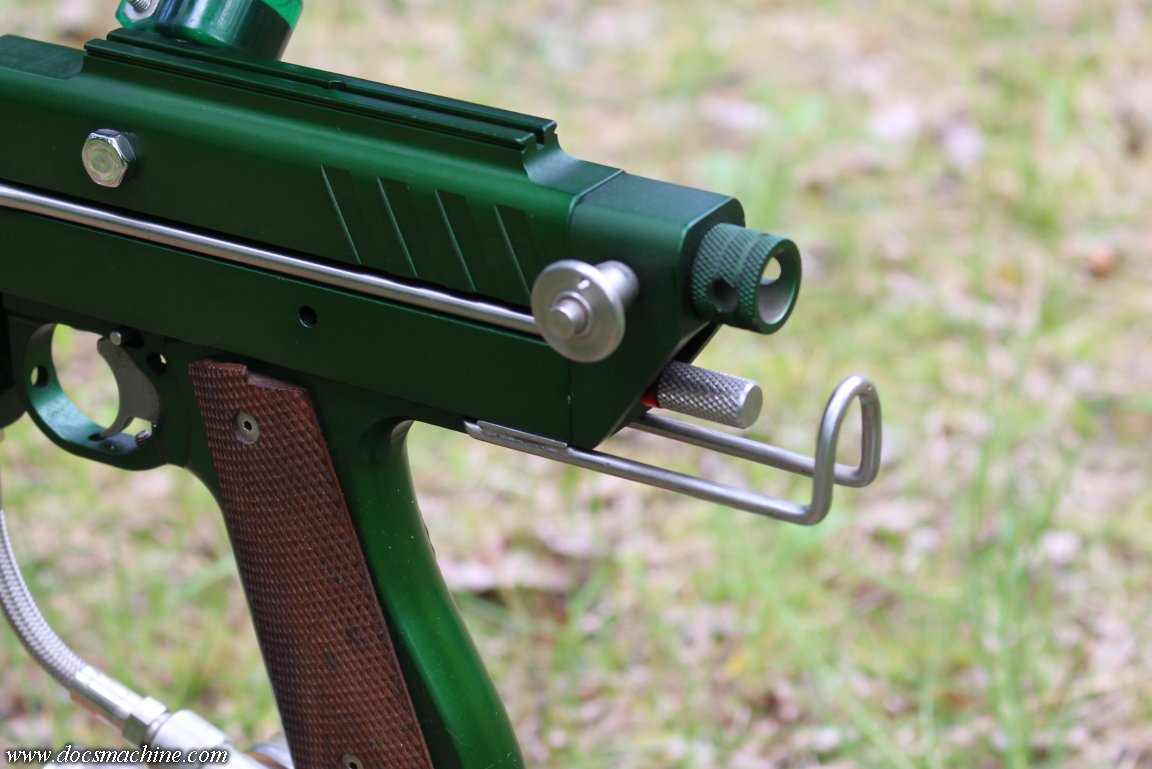
There were a couple of aftermarket beavertails available at the time, but I couldn't find one I liked in green- and it would have cost far too much to have one annoed alone. So, I found an old 5/32" stainless steel stick-welding electrode, I think something like E308, cracked off the flux, chucked the rod up in a drill to spin it, polished it with some sandpaper, and then bent it- with considerable difficulty- into something approximating the shape of a beavertail.
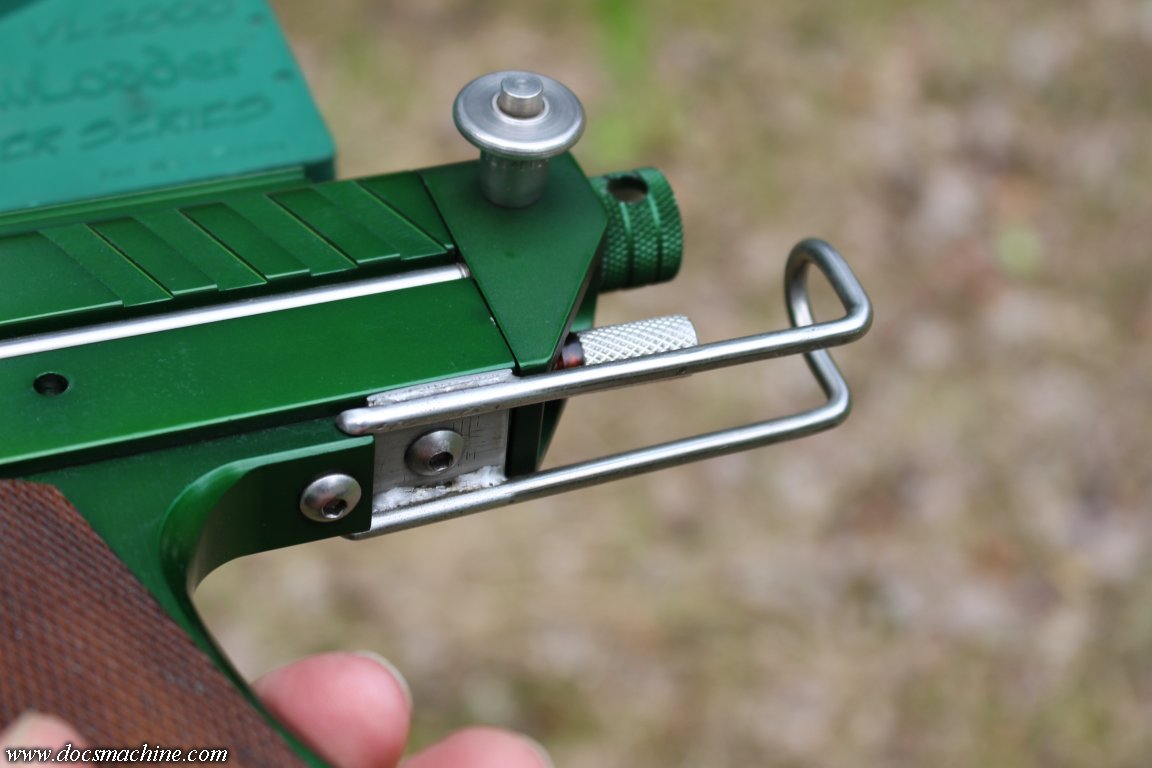
I forget what I cut the square of stainless from, but I fitted things as best I could, then soldered the rod to the plate. Not even silver solder- that's plain 'ol plumbing solder.
The air system is an interesting one. Back in the early-mid 90s, there weren't many HPA systems available. Mainly just the Air America tanks, which virtually everyone used, and a couple of Paintball Mania/Nitro Duck systems. The AA's were around $450 at the time (that's almost a thousand dollars today!) whereas the Nitro Ducks were more like $325-$350. (Today's equivalent of about $200 less.)
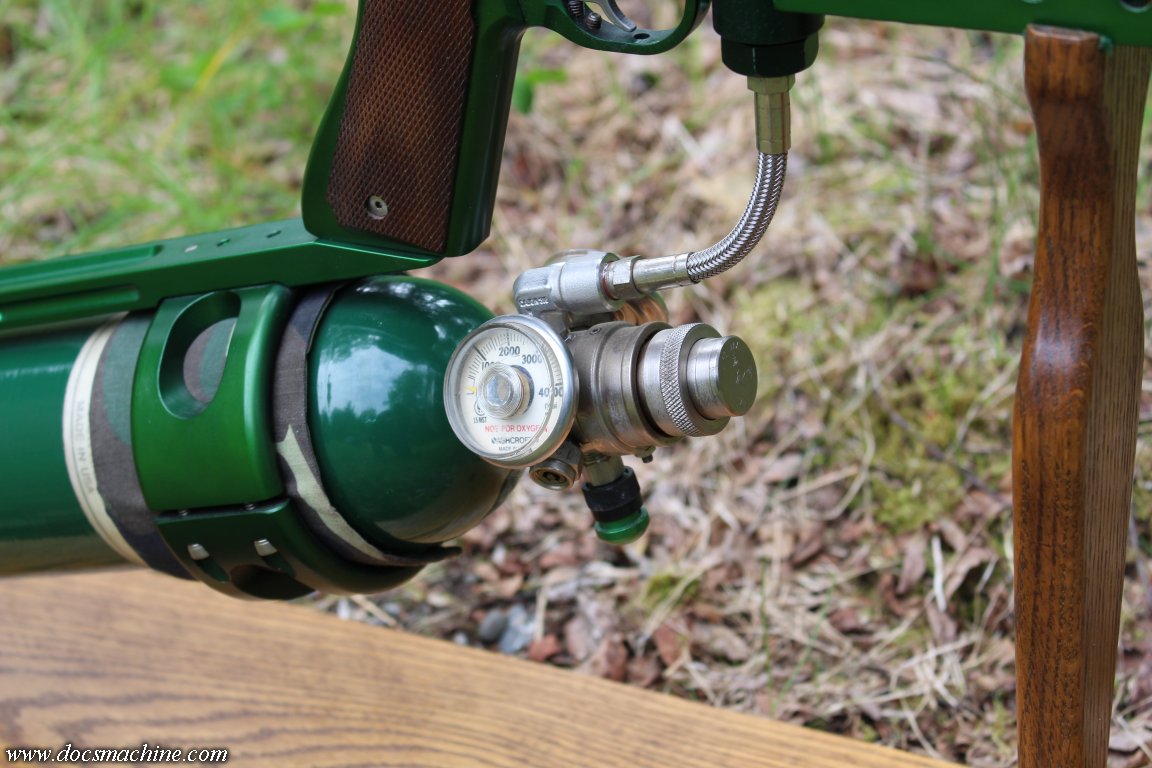
This is an ND "FW71" tank, fiber-wrapped 71 ci, with a brass single-stage regulator. One arguable improvement over the AA systems was the ND had a burst disc for both the HP and the LP side. The LP I think would pop at 1000 psi to protect the gun (normal CO2 pressures are 800-900 psi.)
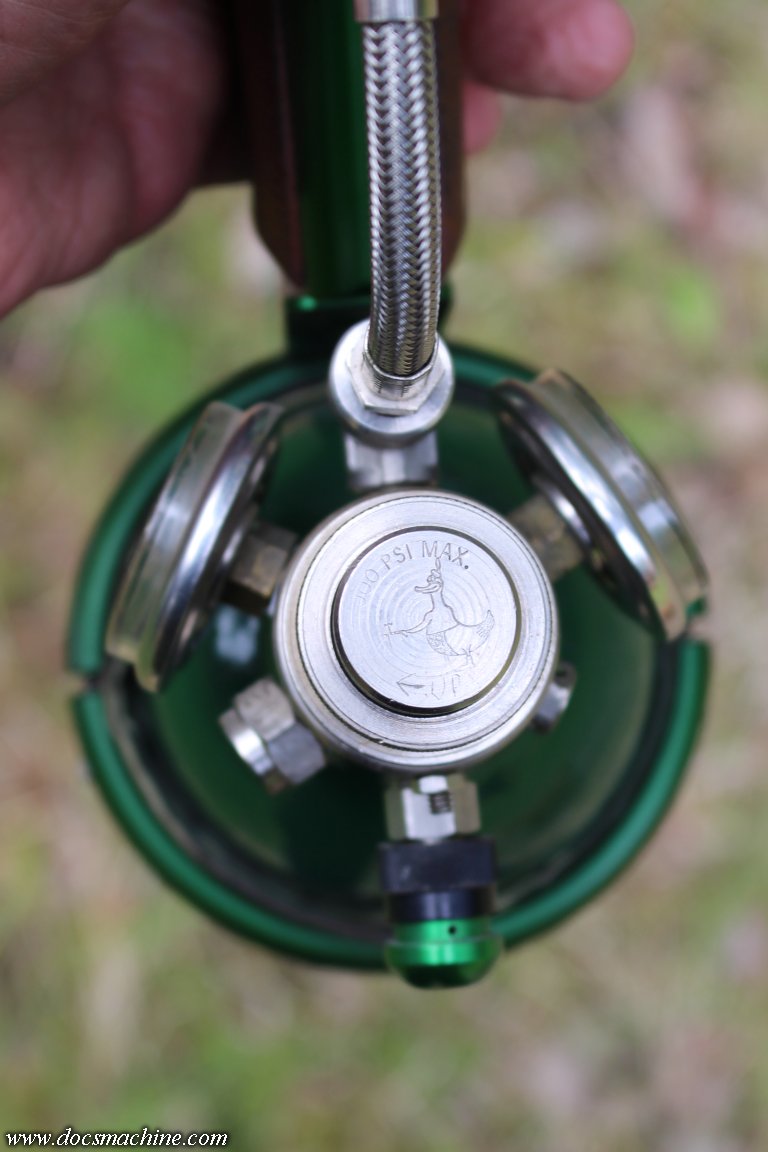
(Note the hand-scratched "UP" arrow. The threads are backwards- it's still lefty-loosey, righty-tighty, but the cap comes out as you turn it as if you're screwing it in. I scratched that on there the first time I used it, since it bugged me a bit.)
The biggest drawback I thought, was the ring-mount, which was originally intended to be simply screwed to the bottom of the grip frame. That never rally sat well with me, but, somewhere around that time, a famous player was on the cover of one of the magazines with a shoulder stock setup that I thought would work pretty well with this tank.
And, it's interesting that a year or two later, that same player had nearly the exact same setup as mine- ND FW tank, ring and stock- during the '96 ESPN exhibition games.
I've had a number of people over the years ask why I don't have an inline reg, since the ND is still just a single-stage regulator. The answer to that is I spent a lot of time "sweet-spotting" the valve and spring combo. A lot of time. As it sits- well, back when you could get paint that fit that .691" barrel - if the pressure is increased, the velocity drops, and if the pressure is reduced, the velocity drops.
One of the maybe half a dozen times I ever had a full fill on that tank (back when I was using it regularly, we mainly had to use 2250 psi Nitrogen tanks) it started out chronographing at 285 +/- maybe 8 (remember when we could get good paint?) and by the time it was down to around 500-600 in the tank, it was around 280 +/- maybe 10fps.
Today, the thing is, of course, way out of hydro. The born date is '95, so the last I could have used it was 2010. Ignoring the fact that few legit fields would allow it, since the tank's been painted, and the label is covered by the ring. The ring was deliberately oversize, and you were supposed to have a pad of some sort in there- mine's an old camo headband, folded up. That's to allow the tank to slightly expand and contract as it's pressurized. At least, that was the explanation I was given- the truth was they machined those out of off-the-shelf thickwall tubing, the ID of which wasn't close enough to actually clamp the tank without a pad. )
And finally, the piece of resistance: By about '96, I considered the gun "done". It had all the cool mods of the day, I as happy with the action, trigger feel and consistency, and so on. So one day back in '96, I borrowed a friend's dad's woodshop, and put together a pretty nice red-oak stand for it:
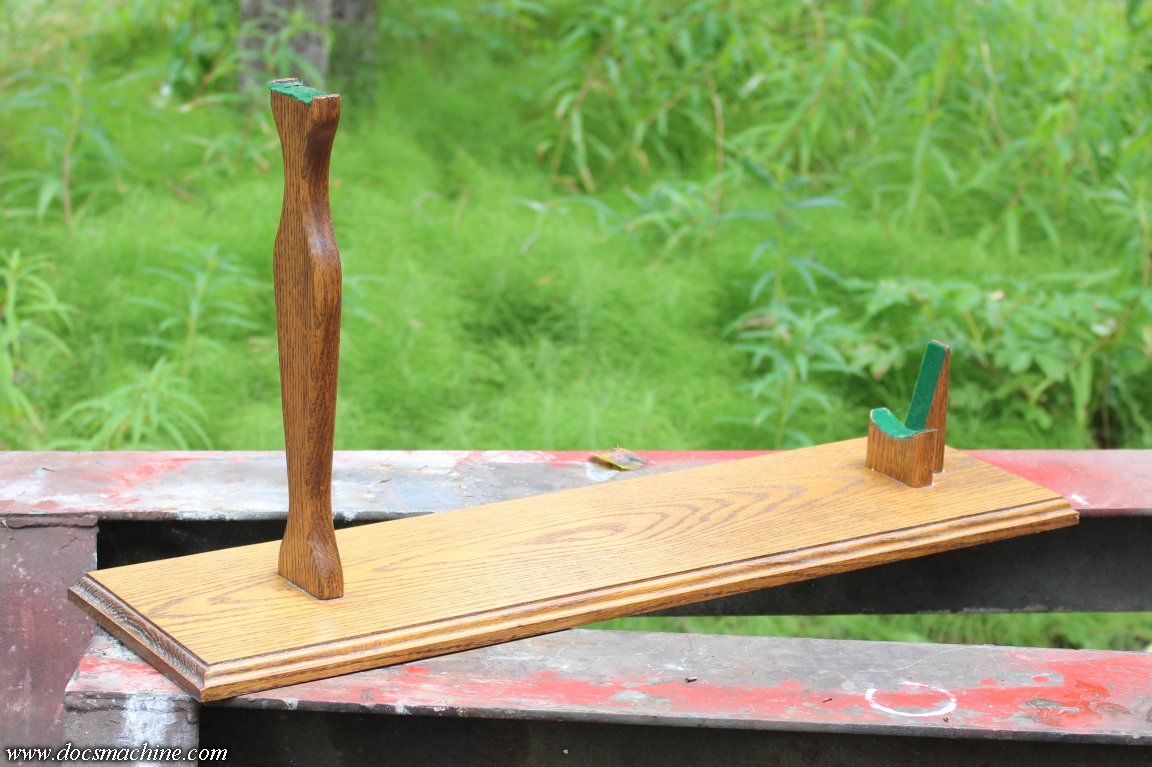
I've always been pretty proud of how that came out, and it still says "August, 1996" on the bottom.
The only changes I've made to it since then was, sometime after I opened this biz in 1998, I picked up a Caswell electroless nickel kit, and used that to plate the regulator (it was originally bare brass) and the four screws for the tank ring. (At the time, I couldn't get stainless 10-24 allen-head screws.)
The last time it fired paint in anger was the '98 APL tournament out on Elmendorf, and the last time I (partially) filled the tank and gassed up the gun was probably around 2014 or 2015 when there was a local field operating here in town.
It's not necessarily the physically-oldest marker I own (those Pumas date back to the mid eighties, and I have a couple of PGPs that date back to the late 80s) and as I said above, it's my next-longest-owned, second only to a Brass Eagle King Cobra. A pump I bought in 1989 as a snot-nosed young lad, with almost-literal paper-route money. The 'proper milling' thing? I tried to duplicate some decorative milling on the pump handle, that I'd seen in one of the magazines, with a drill press. It... kinda worked... 
All in all? Still one of my favorite guns from over the years, although at this point a 100% wall-hanger. I could use it in an informal game- I'd have no qualms about filling to tank to 1500-1800 PSI, and that'd be enough for 600-700 shots, but I'm not going to take it down and refit it with a different rail or ASA. I have other guns and current-hydro tanks for that.
Stick around. I plan to be here for it's fiftieth, and I hope you will be, too.
Doc.
And I've actually had it even longer than that. It's the first AutoCocker I ever owned, it's the first marker I ever milled/machined (heh, okay, with a proper milling machine
) the first one I ever had anodized, the first one I ever ran on HPA, and the first one I ever made a display stand for. I picked up the base gun, used, in... I think 1993. In '94 I got my first milling machine, a badly-worn mill-drill, and by '95, I'd done some very basic milling to the body, based on pictures from the magazines at the time, added the HPA tank and a bunch of bolt-on goodies, and had it anodized.
It took me a long while to piece it all together- the TASO grip frame cost, I think, $75, and I had to make payments on it.
And, naturally, I made some mistakes along the way- buying the wrong parts, buying accessories based on their ad-hype only to find out said ad was 98.9% bulls**t, and making the usual rookie mistakes. One of which was I did the body milling without stripping the original black anodizing off. The shop that did the green, was an industrial anodizer, and so there's spots like this...
... Where there was apparently a faint trace of the adhesive from one of those typical "this is not a toy!" stickers, which caused pitting when it came time to replate.
Same goes for the front shroud:
The upper grooves were a common feature even back then- mainly on the early Evolution 'Cockers- but the side grooves were, at the time, unique. Also note little tricks like the hollow TASO "Rock" Knob- that was one of my signature touches back in the day.
Under the shroud was cutting-edge for back then, but of course a bit antiquated today. Palmer's Rock LPR, Clippard "mini" ram", and a custom-nickeled Palmer's 3-way (pre-Quickswitch) that with the nickeling cost me $65 at the time. And that was mid-90s money, which is almost $140 today!
As I recall, the 90-degree banjo at the end of the ram cost me another $40 (Palmers custom-nickeled that for me, too) and the colored hoses were just starting to appear on the market.
Other little tricks: the TASO frame came with a threaded hole for the vertical-slop adjuster screw (though I ground the end flat, polished it smooth, and rehardened it) but I added the smaller one as a trigger stop. I believe the trigger plate and sear are aftermarket, but I can't recall from who- they, too, might be TASO, which was one of the bigger dealers back in the day.
Out back is an unmodified 'Cocker back block, a TASO "venturi" bolt, and some no-name stainless cocking and pump rods. The beavertial is 100% custom, though.
There were a couple of aftermarket beavertails available at the time, but I couldn't find one I liked in green- and it would have cost far too much to have one annoed alone. So, I found an old 5/32" stainless steel stick-welding electrode, I think something like E308, cracked off the flux, chucked the rod up in a drill to spin it, polished it with some sandpaper, and then bent it- with considerable difficulty- into something approximating the shape of a beavertail.
I forget what I cut the square of stainless from, but I fitted things as best I could, then soldered the rod to the plate. Not even silver solder- that's plain 'ol plumbing solder.
The air system is an interesting one. Back in the early-mid 90s, there weren't many HPA systems available. Mainly just the Air America tanks, which virtually everyone used, and a couple of Paintball Mania/Nitro Duck systems. The AA's were around $450 at the time (that's almost a thousand dollars today!) whereas the Nitro Ducks were more like $325-$350. (Today's equivalent of about $200 less.)
This is an ND "FW71" tank, fiber-wrapped 71 ci, with a brass single-stage regulator. One arguable improvement over the AA systems was the ND had a burst disc for both the HP and the LP side. The LP I think would pop at 1000 psi to protect the gun (normal CO2 pressures are 800-900 psi.)
(Note the hand-scratched "UP" arrow.
The threads are backwards- it's still lefty-loosey, righty-tighty, but the cap comes out as you turn it as if you're screwing it in. I scratched that on there the first time I used it, since it bugged me a bit.)The biggest drawback I thought, was the ring-mount, which was originally intended to be simply screwed to the bottom of the grip frame. That never rally sat well with me, but, somewhere around that time, a famous player was on the cover of one of the magazines with a shoulder stock setup that I thought would work pretty well with this tank.
And, it's interesting that a year or two later, that same player had nearly the exact same setup as mine- ND FW tank, ring and stock- during the '96 ESPN exhibition games.
I've had a number of people over the years ask why I don't have an inline reg, since the ND is still just a single-stage regulator. The answer to that is I spent a lot of time "sweet-spotting" the valve and spring combo. A lot of time. As it sits- well, back when you could get paint that fit that .691" barrel
- if the pressure is increased, the velocity drops, and if the pressure is reduced, the velocity drops.One of the maybe half a dozen times I ever had a full fill on that tank (back when I was using it regularly, we mainly had to use 2250 psi Nitrogen tanks) it started out chronographing at 285 +/- maybe 8 (remember when we could get good paint?) and by the time it was down to around 500-600 in the tank, it was around 280 +/- maybe 10fps.
Today, the thing is, of course, way out of hydro.
The born date is '95, so the last I could have used it was 2010. Ignoring the fact that few legit fields would allow it, since the tank's been painted, and the label is covered by the ring. The ring was deliberately oversize, and you were supposed to have a pad of some sort in there- mine's an old camo headband, folded up. That's to allow the tank to slightly expand and contract as it's pressurized. At least, that was the explanation I was given- the truth was they machined those out of off-the-shelf thickwall tubing, the ID of which wasn't close enough to actually clamp the tank without a pad. )And finally, the piece of resistance: By about '96, I considered the gun "done". It had all the cool mods of the day, I as happy with the action, trigger feel and consistency, and so on. So one day back in '96, I borrowed a friend's dad's woodshop, and put together a pretty nice red-oak stand for it:
I've always been pretty proud of how that came out, and it still says "August, 1996" on the bottom.
The only changes I've made to it since then was, sometime after I opened this biz in 1998, I picked up a Caswell electroless nickel kit, and used that to plate the regulator (it was originally bare brass) and the four screws for the tank ring. (At the time, I couldn't get stainless 10-24 allen-head screws.)
The last time it fired paint in anger was the '98 APL tournament out on Elmendorf, and the last time I (partially) filled the tank and gassed up the gun was probably around 2014 or 2015 when there was a local field operating here in town.
It's not necessarily the physically-oldest marker I own (those Pumas date back to the mid eighties, and I have a couple of PGPs that date back to the late 80s) and as I said above, it's my next-longest-owned, second only to a Brass Eagle King Cobra. A pump I bought in 1989 as a snot-nosed young lad, with almost-literal paper-route money.
The 'proper milling' thing? I tried to duplicate some decorative milling on the pump handle, that I'd seen in one of the magazines, with a drill press. It... kinda worked... All in all? Still one of my favorite guns from over the years, although at this point a 100% wall-hanger. I could use it in an informal game- I'd have no qualms about filling to tank to 1500-1800 PSI, and that'd be enough for 600-700 shots, but I'm not going to take it down and refit it with a different rail or ASA. I have other guns and current-hydro tanks for that.
Stick around. I plan to be here for it's fiftieth, and I hope you will be, too.
Doc.


Comment