Welcome to MCB! The most popular and active paintball forum on the internet. Thank you for stopping by!
If this is your first visit, please take a moment to check out the FAQ by clicking the link above. You will need to register before you can post. Simply click the Register link above to get started.
To begin browsing, select a forum from the list below.
Do you think a "6 way" valve (like the g force gemini kit) that would thread into a standard front block would be a marketable product at this point in time?
The answer I’m hoping for is “I’m about to find out, I”ll sell you one and name it after you.”
It's just tarnish. Nickel is mostly resistant to oxidation, but not not entirely. Ever heard the old term "triple chrome"? That meant the platers put three layers on a part: a layer of copper, which 'fills in' slight scratches and tiny pits, the layer of nickel which gives the bright silver color and the main protection to the part, and then a layer of chromium, which gives the part it's brilliance, as well as "sealing" the nickel from oxidation.
It's basically like painting a car- the copper is the primer, the nickel is the color coat, and the chromium is the 'clear coat'.
In most cases, nickel by itself is suitably durable even for all-weather use. IE, Palmer's Typhoons and the like.
But, in some cases- and in my experience especially over aluminum- if not applied well, and not cared for properly (stored in high humidity, paint or other gunks left on it for protracted periods, etc.) it can easily tarnish.
It's also possible that the nickel was applied much too thin (poor plater or just as an attempt to save money) and the aluminum is tarnishing under the nickel.
The only restoration is maybe trying some metal polish. Flitz or Brasso or Mother's, etc. Scrub a small spot and see if you can buff off the tarnish- if you're careful, you might try light power tools, like those little felt polishing discs and cones that come with Dremels.
If you're just making the tarnish shiny, it's the aluminum, and there's no way to save it except by deplating and replating, or deplating and then anodizing.
If the tarnish does go away, keep in mind you've actually removed some of the nickel, which was probably very thin to start with, and the aluminum may oxidize under it.
How would zero gravity paintball games differ from current modes of play?
-Zero gee, but still shirtsleeve weather (IE, indoors) or zero gee, in space?
As noted, no ball drop would be the big one, but if there's an atmosphere, range is still limited due to drag. In outer space, of course, that rope you fired at your opponent would keep going until it hit something, or was pulled in by some gravity well.
At only 200 MPH though, it'd take a couple centuries just to pass the orbit of Pluto.
Now, either way, the actual play style would have to change a LOT. I mean, if you jump up into the air, you need some way to either stop yourself, or at least change direction. Thruster packs? A couple extra 114 tanks with little adjustable gas jets? Might not be enough thrust to properly dodge. More likely the field would have to be basically 3D airball, with the bunkers (or solid shields, maybe) on some sort of support structure or scaffolding, or a whole web of support ropes.
Something sturdy enough that "flying" players could grab and hold, or "jump off" from, but with enough give or elasticity that "crashing into" one wouldn't hurt. Masks would have to be much better secured.
Other issues: It would be possible to run into floating paint, and at the end of the day, there'd be "clouds" of spray and random balls floating about. You'd have to take Spock's advice and start thinking 3-dimensionally; else you could get flanked overhead or from underneath.
[/As a machinist, how often do you do an operation by hand?
I don't mean break the corner with a file on the lathe, I mean, clamp the part in a vice and file/cut something by hand (like squaring a hole ...)
-Pretty much constantly?
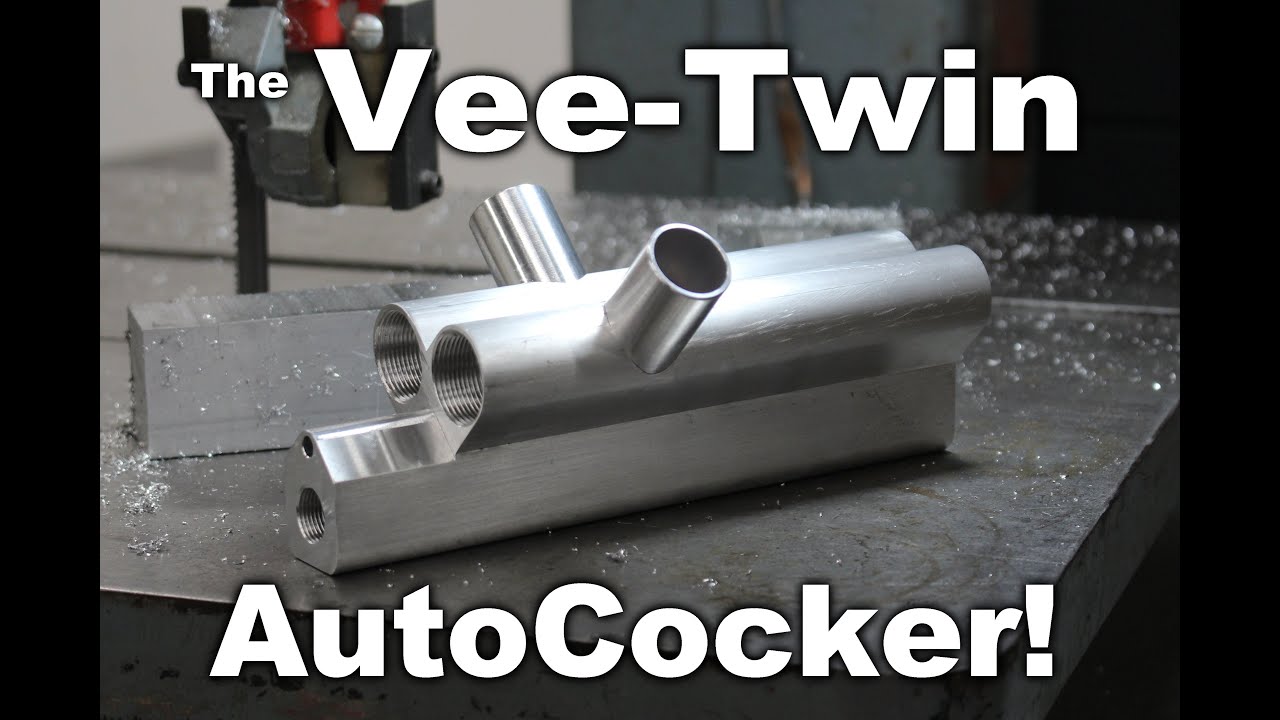
I'm an old-fashioned machinist, both in how I learned/was trained, and in the equipment I have. Save for the feed necks, which I made on my new-to-me CNC lathe, every bit of those Vee-Twin bodies has been done on manual machines. The only "automated" part is the power feed on the X axis. Hundreds of manual tool changes, thousands of turns of the cranks, constantly keeping track of dimensions and spacing and sizes, trying to work out the order of operations 'on the fly'...
In the first Vee-Twin video...
You see pretty much exactly how I make a part. That's not staged or mocked up- I was recording the actual work. As I said, the only "automatic" action was the power feed for the table- everything else was 100% manual and pure brainpower.
This question made me think of my Dad. He would not let me touch either the mill or lathe until I had made a cube with right angles and flat surfaces with hand tools (tested on a flat table with precision angle gauges and dial indicators down to +/- a 0.001. Learning to lap surfaces is a great skill to learn. I remember my Dad making many parts by hand for prototype mechanical assemblies. In particular remember him hand scraping the ways for a LeBlond lathe he bought from work for his home shop.
As a machinist, how often do you do an operation by hand?
I don't mean break the corner with a file on the lathe, I mean, clamp the part in a vice and file/cut something by hand (like squaring a hole ...)
I work on Nuclear equipment, and safety wire is still used on some of those assemblies. I tell ya, getting a 1/16th hole through the head of stainless 3/8-16 bolt isnt too bad, but you get about 4 bolts to a drill bit.

 You'd have to take Spock's advice and start thinking 3-dimensionally; else you could get flanked overhead or from underneath.


Leave a comment: